Independent Benchmark Study
By Dr. Christian Fischer- Chief Scientific and Medical Officer AliveDx
Clinical laboratories are operating under increasing pressure around growing test volumes, constrained staffing, and the need to deliver faster, more comprehensive diagnostic insight.
At the same time, many systems are evaluated under controlled or optimized conditions that do not fully reflect how laboratories actually function day to day.
That raises a fundamental question:
How do you know how an instrument will perform in real-world laboratory conditions and not just in theory?
See how MosaiQ® Instrument performs under real-world laboratory conditions—validated by CapRock Global.
Why This Study Matters
To better understand real-world performance, AliveDx commissioned an independent workflow evaluation conducted by CapRock Global, a laboratory workflow and industrial engineering consultancy.
The objective was not to measure theoretical capacity, but to observe how the MosaiQ® multiplexing system performs within routine laboratory workflows, including:
This approach provides a more accurate view of how systems behave under the types of conditions laboratories face every day.
What the Study Showed
The results were consistent and clinically meaningful:
Importantly, these results were sustained over extended operation, with no observable drift in performance.
From a workflow perspective, this level of consistency is just as important as peak throughput.
Multiplex Testing: More Insight from Every Sample
One of the key contributors to this performance is multiplex microarray technology.
In this study, the MosaiQ AiPlex® Celiac Disease panel measured four analytes per sample (tTG IgA, tTG IgG, DGP IgA, and DGP IgG), along with a Total IgA flag to support interpretation.
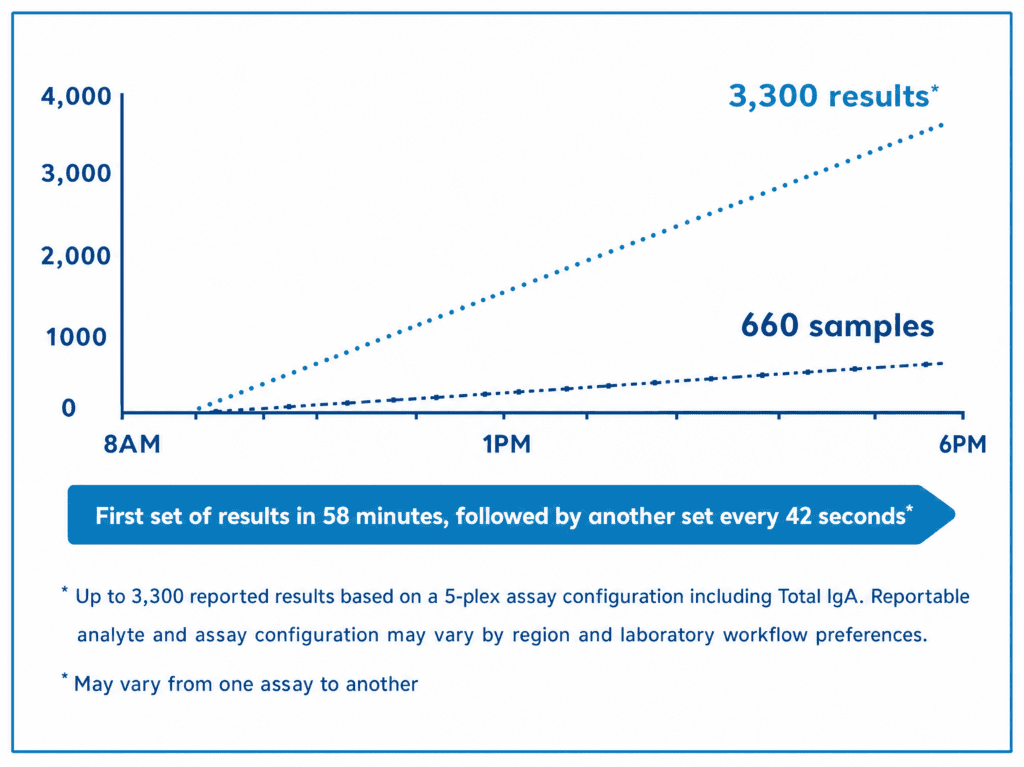
This resulted in:
In contrast, traditional single-analyte workflows require sequential testing, often increasing turnaround time and adding operational complexity.
Representative High-Volume Shift Focused on Throughput¹,²
What This Means for Laboratory Workflow
Beyond throughput, the study provides important insight into how systems integrate into daily laboratory operations.
A key observation was that:
The majority of system runtime occurred without direct operator interaction.
Hands-on time was primarily associated with standard pre-analytical activities, such as sample preparation and handling, rather than instrument-driven requirements.
In practice, this means:
In environments where staffing is limited, this has a meaningful impact on efficiency and workload distribution.
Flexibility Matters as Much as Performance
Another important outcome of the study was the system’s ability to support multiple workflow models within the same platform.
MosaiQ demonstrated flexibility to operate in both:
This allows laboratories to adapt testing workflows based on:
Rather than forcing laboratories into rigid processes, the system adapts to how the lab operates.
Why Independent Validation Is Important
What makes this study particularly valuable is not only the results—but how they were obtained.
Performance was evaluated through direct observation using time and motion methodology, capturing:
This provides a more complete picture of how the system performs in practice—not just under ideal conditions.
Final Perspective
Laboratories today require more than high-performing instruments. They need systems that integrate seamlessly into workflows, support staff efficiency, and scale with demand.
This independent evaluation demonstrates how multiplex testing, combined with flexible workflow design, can support those needs in a measurable and practical way.
Explore the Full Study
For a deeper look at the methodology, data, and detailed analysis:
Download the full CapRock Benchmark Study white paper
©2026 – AliveDx Suisse SA – AliveDx, AliveDx logo, MosaiQ, AiPlex and MosaiQ AiPlex are trademarks or registered trademarks of AliveDx group companies in various jurisdictions. Not all methods may be available in all territories. Subject to regulatory clearance in some territories.
Availability may vary by country and is subject to local regulatory requirements. Certain products described may not be available in the United States and are not cleared or approved by the U.S. Food and Drug Administration (FDA) for clinical use.
References
- CapRock Global Solutions. AliveDx MosaiQ Instrument Workflow Analysis Report, High Throughput Study in Salt Lake City, December 8-12, 2025. Published March 6, 2026.
- CapRock Global Solutions. Independent Workflow Performance Study MosaiQ® Solution White Paper. 2026.